The Print Center’s 87th Annual International Competition features works by 43 of the finest contemporary artists working today. This year the competition was juried by Irene Hofmann, Phillips Director & Chief Curator, SITE Santa Fe. The Print Center’s Annual International Competition is one of the most prestigious and oldest juried exhibitions in the United States. This online exhibition presents portfolios of the work of the 33 semi-finalists and 10 finalists.  It provides a unique opportunity to view the work of local, national and international artists in a forum which emphasizes individual talent and expressiveness rather than a specific exhibition topic. Hofmann reviewed over 2,700 images submitted by 549 artists. Taryn McMahon, Lydia Panas and Soledad Salamé were selected for solo exhibitions, which are on view at The Print Center June 7 – July 27, 2013. Awards for the competition will be announced on July 1.

Philadelphia’s Print Center hosts great print exhibitions, among other things, and you should definitely pay them a visit when you’re in town. I’m lucky to be a Semi-finalist in their annual competition this year; you can see all of the artists online here. And the three solo exhibitions are on view through the end of July.
Untitled

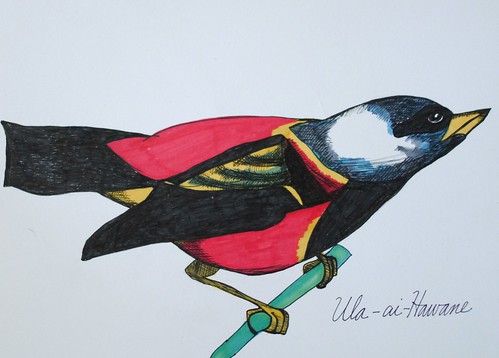
A small Hawaiian honeycreeper. It liked the seeds and flowers of a particular sort of palm tree, and when those started to disappeared, so did the bird. Its name means “the red bird that eats the fruit of the hawane palm”. Last seen in 1892.


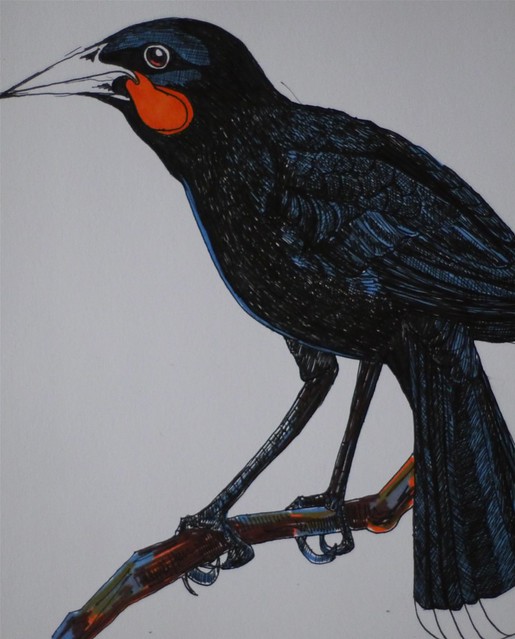
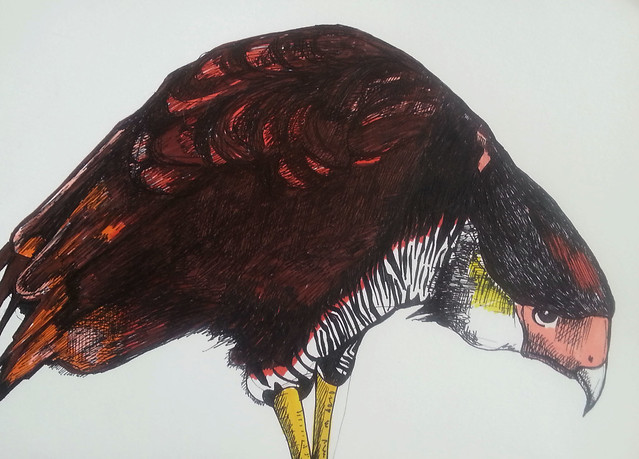
“No kid is safe from their attacks. Should a number be together, the birds unite their forces, and, with great noise and flapping of their wings, generally manage to separate the weakest one and dispatch it….The birds are cruel to the extreme, and the torture sometimes inflicted upon the defenseless animals is painful to witness. Even when food is plenty, they often attach living animals instead of contenting themselves with the carcasses of those already dead, seeming to delight in killing.”- Edward Palmer, 1876

It’s impossible to tell now how bloodthirsty this bird, a member of the falcon family, actually was; this description was written by a goat herder on Guadalupe Island, off the coast of Mexico. Goat herders banded together in the 19th century and conducted a formal campaign to drive this particular bird to extinction. The Caracara occasionally fed on young goats, though it seems like their role as predator has been exaggerated.

It stands to note that its home was at that time being devastated by tens of thousands of goats gone feral, leading to the extinction of several other endemic species, caused by the near-total destruction of habitat. It also stand to note that goats were not endemic to the island, but had been brought there by settlers. They were originally brought there in the early 19th century by Russia whalers for provisions when stopping over. Goats eventually eliminated most vegetation on the island, along with several other species, before their population collapsed.


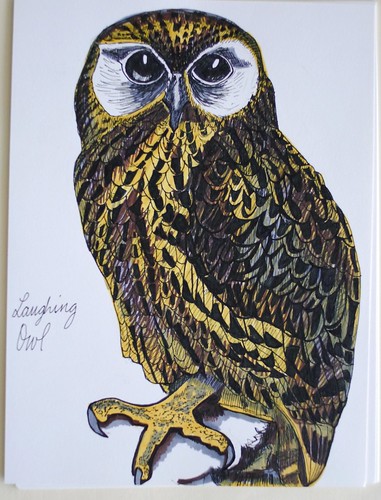
Untitled

Look at how handsome he is. This is another New Zealand bird. His cry sounded like “a series of dismal shrieks frequently repeated”,  or, alternately, as “a peculiar laughing cry, uttered with a descending scale of notes”. No one is really sure what happened to the Laughing Owl;  by the time European naturalists starting paying attention to it it was already in decline. Some say fewer Maori rats meant fewer owls. Others say new introduced predators took their toll; these owls seemed to have walked more than flown. They had disappeared by the early 20th Century, though like many extinct birds, there are people who say that there’s one or two hiding out there somewhere. Errol Fuller has this advice for Laughing Owl fans:

Anyone still believing in the Laughing Owl’s survival and hoping to find its last resting place, might do worse than learn to play the accordion… “It could always be brought from its lurking place in the rocks, after dusk, by the strains of an accordion. Soon after the music had commenced the bird would silently flit over and face the performer, and finally take up its station in the vicinity, and remain within easy hearing till it had ceased.”

There you have it: an accordion-loving owl. I’ve found my favorite extinct bird.


From New Zealand. The Maori prized their feathers and wore them in battle. They made jewelry, amulets and carved boxes especially to hold Huia feathers. They gave them to each other as tokens of friendship and of respect, and used them in funeral rites. At first only powerful chiefs were allowed to wear their feathers, but soon after the Europeans arrived that went by the wayside, and anyone who could get their hands on them started collecting and wearing them. The Europeans themselves were happy to have stuffed Huias decorate their colonial drawing rooms, and many others were exported to museums and private curiosity cabinets back home.


Spring!

Here’s some exciting new things happening this year:

invitation_artists' book hungary

Exhibitions!

FIFTH INTERNATIONAL ARTISTS BOOK EXHIBITION 2013

King St. Stephen Museum in Székesfehérvár, Hungary

Opening Saturday, May 18th and running till October 27th.

(in case you’re in Hungary.)

There’s an online-only exhibition coming up in June with the Print Center in Philadelphia; I’ll post the link when it’s up.

Classes! I’ll be proselytizing the wonders of metal type in June and July at The Center for Book Arts:

Intro to Letterpress: Business Cards and Stationery

June 1 – 2 , Saturday and Sunday, 10am – 4pm

Intro to Letterpress: Postcards, Pamphlets & Leaflets

July 13 – 14 , Saturday and Sunday, 10am – 4pm

Residency!

I’m SO EXCITED for this: the LMCC Swing Space Residency at Governor’s Island. I’ll be working there starting in August, running through December, developing new information to be distributed in print for free.

Speaking of which, it’s still spring, which means!

New pamphlet is in the works. This is a hint as to what it’s all about.


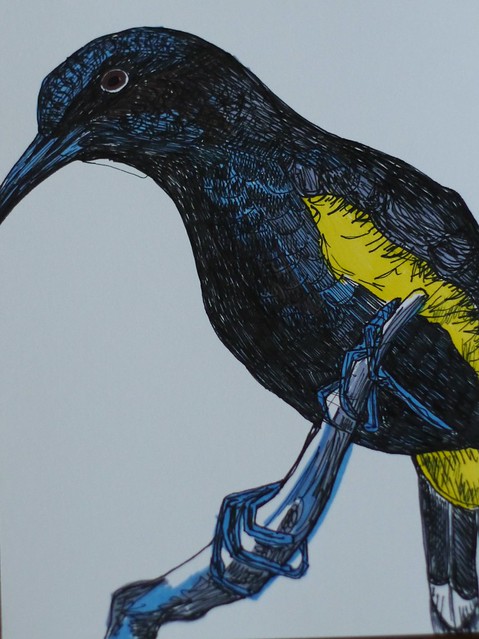
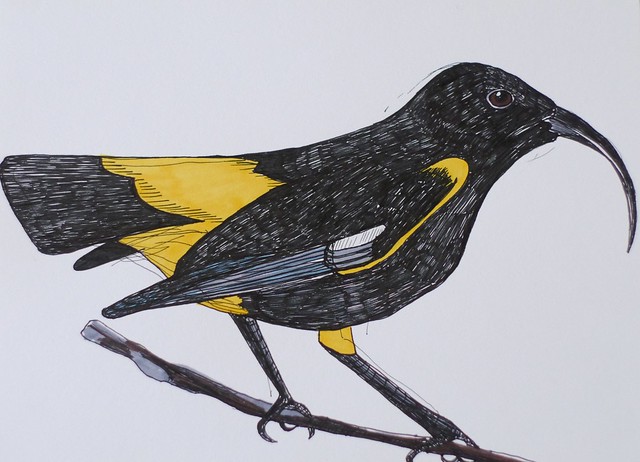
Generations of Hawaiian Royalty trapped Mamos and used their yellow rump feathers for ceremonial royal war cloaks. The Kings of Hawaii supposed ruled that anyone who trapped a Mamo was prevented from killing it, and were required to turn them loose once their yellow feathers had been plucked. It’s impossible to say if this was an effective edict, or if the Mamo really wanted to go out without half its feathers.  By the end of the nineteenth century they had almost completely disappeared, probably due to loss of habitat coupled with hunting.


Based on a colored engraving by Jacques Barraband from F. Levaillant’s Histoire Naturelle des Perroquets. Vol 2, Paris, 1801-5.

Wikipedia says: The Mascarene Islands (or Mascarenhas Archipelago) is a group of islands in the Indian Ocean east of Madagascar comprising Mauritius, Réunion, Rodrigues, Agaléga, Cargados Carajos shoals, plus the former islands of the Saya de Malha, Nazareth and Soudan banks.

Errol Fuller says: “In all probability, the very last living Mascarene Parrot was kept, far from its natural home, in the Zoological Gardens of the King of Bavaria in Munich.”

This makes him a fitting bird for today, the day when I leave for a well-deserved vacation in Germany. I’ll send postcards.


@