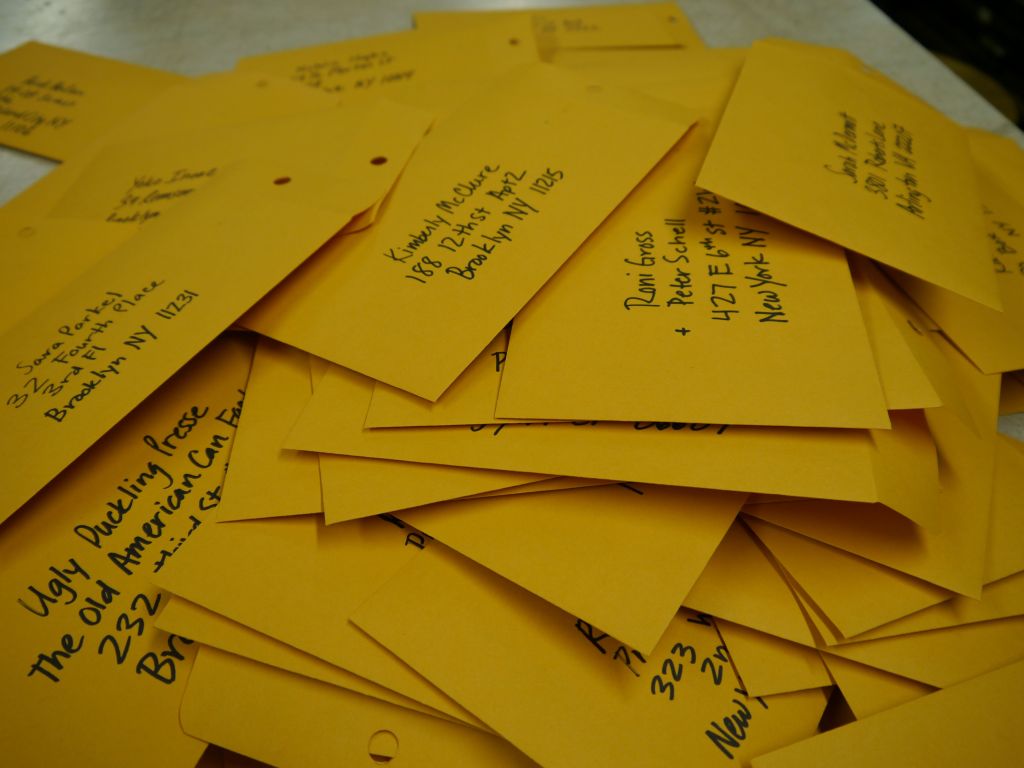
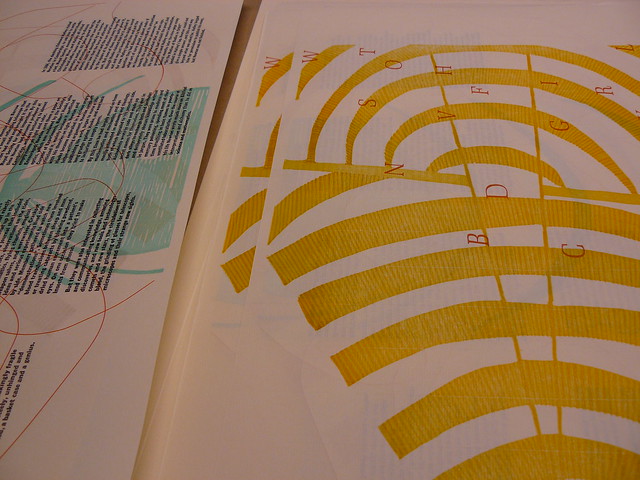
I’m frantically trying to finish 2000 invitations to the Center for Book Arts Annual Benefit and Auction (which you should come to! or donate to! or bid on the online auction which I’m also frantically putting together! Among a multitude of other things! Like a spring schedule! And a summer schedule!). I am also trying to understand why my internet service is so terrible, and why it’s snowing in March, and trying to make time to figure out where to stay in Berlin, and failing, and attempting to start training for the Brooklyn Half.
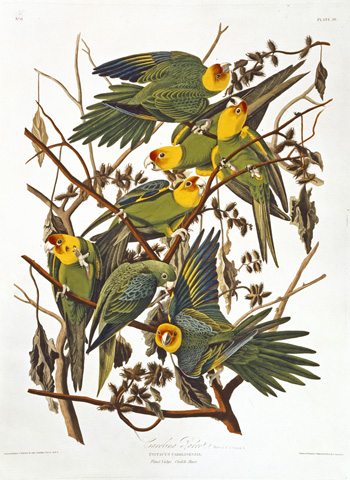
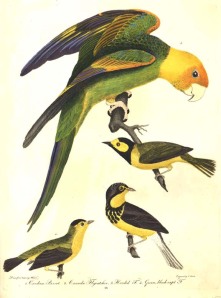
from the Birds of America, John James Audubon (1785 – 1851) Hand-coloured engraving, 1827 – 1830
Length: 30cm (12in)
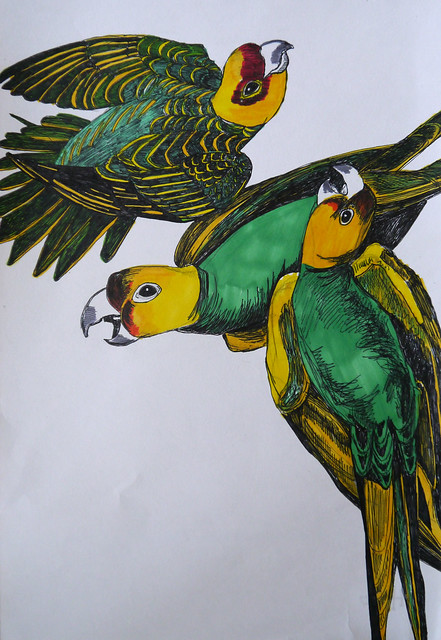
Description- Adult: forehead, lores, area around eyes and upper cheeks orange; remainder of head, throat and upper part of neck yellow; outer webs of primaries marked yellow towards their base; bend of wing, carpal edge and thighs yellow; rest of plumage green, paler on underparts; bill horn-coloroured; legs and feet pinkish brown
The Carolina Parakeet was the only parrot species native to the eastern United States. It was found from southern New York and Wisconsin to the Gulf of Mexico, and lived in old forests along rivers.
Supposedly, flocks of Carolina Parakeets had such strong bonds that when some of their members were killed the remainder of the flock returned to their bodies repeatedly until all were shot. A flock would therefore inspect a feeding site carefully before landing.
Song: Loud quarrelsome screams given in flight
Behavior: Social and gregarious. Occurring in flocks except in breeding season when pairs nested in dense colonies. Mated for life. Roosted communally in hollow trees. Fed in bottomland forests, riverbanks, and cypress swamps on tree and grass seeds, thistle, fruits and berries.
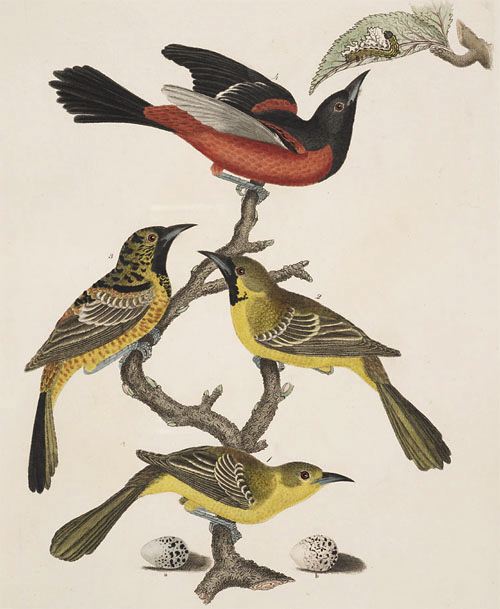
Alexander Wilson’s rendering
Carolina Parakeets were probably poisonous—John James Audubon noted that cats apparently died from eating them, and they are known to have eaten the toxic seeds of cockleburs. As forests were cleared to make room for farmland, farmers would shoot them as they considered them pests. Flocks were plentiful in the 18th and 19th centuries. Audubon described a flock attacking grain in the fields: Flocks of these birds …cover them so entirely, that they present to the eye the same effect as if a brilliantly covered carpet had been thrown over them.
Mark Catesby’s parakeet
Parakeets were hunted for its feathers, particularly as decoration for ladies hats; the pet trade; for sport and as pests. No one knows when the last wild parakeet died; the last two parakeets in captivity lived together in the Cincinnati Zoo for thirty-two years. Lady Jane passed away in 1917 and her companion Incas passed in 1918, ironically in the same cage that the last known Passenger Pigeon, Martha, had passed away in four years earlier.
Rumors of their continued existence circulated for long afterwards. Bird enthusiasts claimed to have seen isolated examples deep in the Carolina swamps, most of which is also gone now, up until the 1930’s.
Alexander Wilson started off as a Scottish weaver, then as a poet, then itinerant peddler. His poetry tended towards the political, which got him thrown into prison for libel. Once released, he emigrated to America for a fresh start as a schoolteacher, first in New Jersey then Pennsylvania. It was only after he got to Pennsylvania that he got interested in birds.
The naturalist William Bartram was his neighbor and encouraged the penniless, self-educated immigrant to start collecting and studying birds. Wilson began teaching himself everything he could about birds, and how to illustrate them.
In 1802 he began traveling around looking for birds to paint, and collecting subscriptions for his planned illustrated ornithological study of all the birds of North America. He ended up with 268, 26 of them completely new, in his nine-volume American Ornithology. One of the people he tried to solicit for a subscription was Audubon himself, who was still in Kentucky in 1810, minding his soon-to-be-bankrupt mercantile business. Wilson’s book is often cited as one of the inspirations of Audubon’s Birds of America.
Birds books didn’t start with John James Audubon, and they didn’t end there either. Before Audubon, there was Mark Catesby, who in 1722 was sent by the Royal Society to the Carolinas on a plant-collecting expedition.
Over the next four years Catesby traveled around Eastern North America and the West Indies, collecting samples of plant and animal life. After returning to England, he spent seventeen years working on his Natural History of Carolina, Florida, and the Bahama Islands: drawing samples and etching plates himself for the publication, the first to use large. folio-sized color plates in a natural history book.
He learned to do the engraving and hand-coloring of the plates himself to keep the cost of producing it down, bookmaking being as foolish a financial investment then as it it today. He painted more birds than anything else, placing them in the middle of the page with some element of their habitat. It is the first true ornithological text dealing with American birds, and sparked a wave of interest in the topic.
AND you can read his masterwork here, online, because the internet is amazing, when it’s not terrible:
I caught the last day of the Rosemarie Trockel show at the New Museum last Sunday; not only was there a surprise collection of artist books on the fourth floor, there was also a natural history-ish installation on the second floor, which included other things made by other people that Trockel liked. Which is how I accidentally saw the above, one of the etchings made by Robert Havell for James Audubon’s Birds of America. A nice coincidence, considering I had just finished the great biography of Audubon by Richard Rhodes. Things that I’ve learned from this include:
Fights conducted by letter take a long time. Audubon started off life as a businessman, then failed, which prompted him to take off across the newly-acquired American wilderness, without his family, shooting, collecting, and drawing birds in order to produce his masterwork. Then he went off to England for several years, to find a publisher, produce the edition and to raise subscriptions for the project. His wife Lucy was amazingly supportive in the face of all of this, but inevitably the distance between them took a toll. Letters between the two could take several months to arrive, if they arrived at all and didn’t get lost along the way. Going back and forth about when and where they would live together again took years, and misunderstandings multiplied over time. If you think that email arguments are crap, just think about that.
Genius bird enthusiasts travel in style. When Audubon sailed from England to New York in 1836, he brought with him “a menagerie of 260 live birds, three pointers, and a ‘brace of tailess Manx cats’.” Only 15 birds survived the crossing, but ‘the cats are well.’
The big money has never been in bookmaking. Only about 160-170 subscribers stuck with the original project until the end, which meant that despite all his hard work, when the original edition was completed, Audubon was only slightly ahead, and still owed the printer Havell for the last 15 sets. Rhodes estimates the cost of the edition at upwards of $2 million in today’s dollars. This was all money raised by Audubon himself through subscriptions and sales he solicited himself; he received no grants or gifts.
If you have any interest in birds or natural history or American history, it’s a great book.
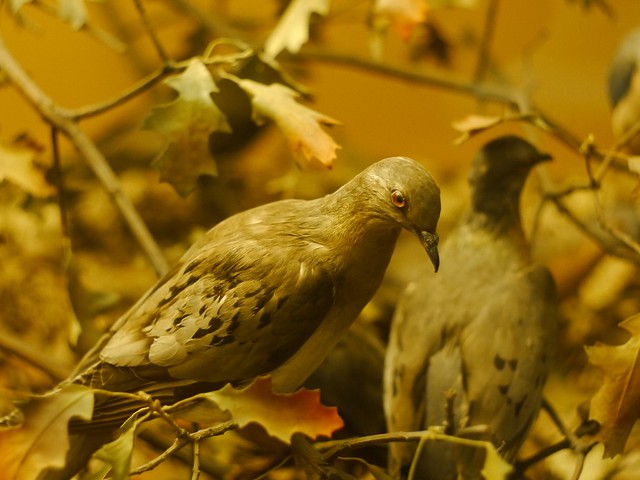
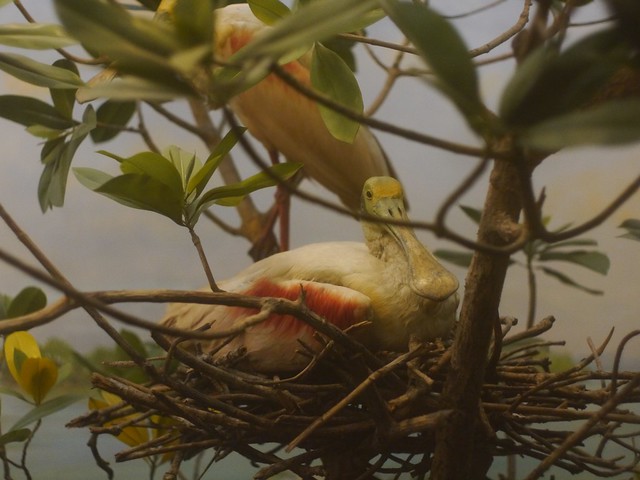
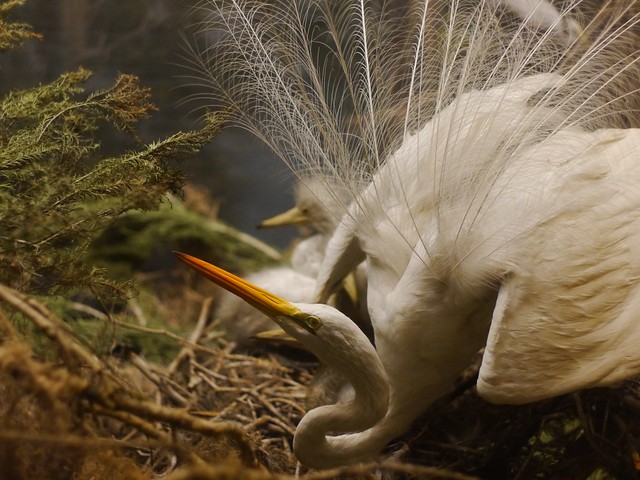
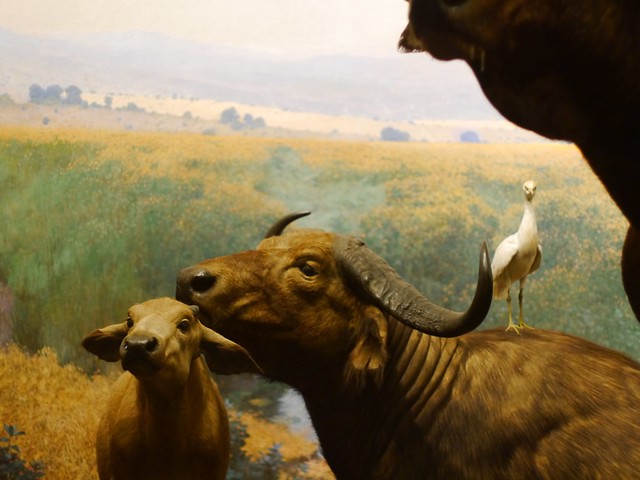
In the interest of research for my new book, I went to the American Museum of Natural History on Sunday; it’s a strange place, which I haven’t visited in years. I thought I knew what natural history was, but perhaps I’m wrong about that. In any case, I enjoyed taxidermy at its finest. Birds of the World! (and also of NY State.)
This year I’ll be working on a new book project: a field guide to extinct birds. There, I’ve said it, now it has to happen. At this point I’m thinking about producing it in three versions: a deluxe letterpress edition in a box with accompanying prints; a digitally-printed version with a letterpress wrapper; and an animation that you can watch for free-which will actually be different content, but complimentary, talking about migration.
I’m interested in the field guide since it’s one of those kinds of books that probably aren’t going to continue to exist in paper form for much longer-digital apps just seem like they will do the job of helping you identify a birds much quicker and easier that a field guide can, what with video and sound and all. But whenever I see birders in Prospect Park, they’re still carrying their dog-eared paper books with them. I have a feeling that the average birder is pretty attached to whichever field guide they began birding with. And the ways that people have come up with to classify and represent birds in two-dimensional form so that an amateur can identify them is interesting, and the ways that has evolved over the years is interesting, and amateur scientists are always interesting, and so on…
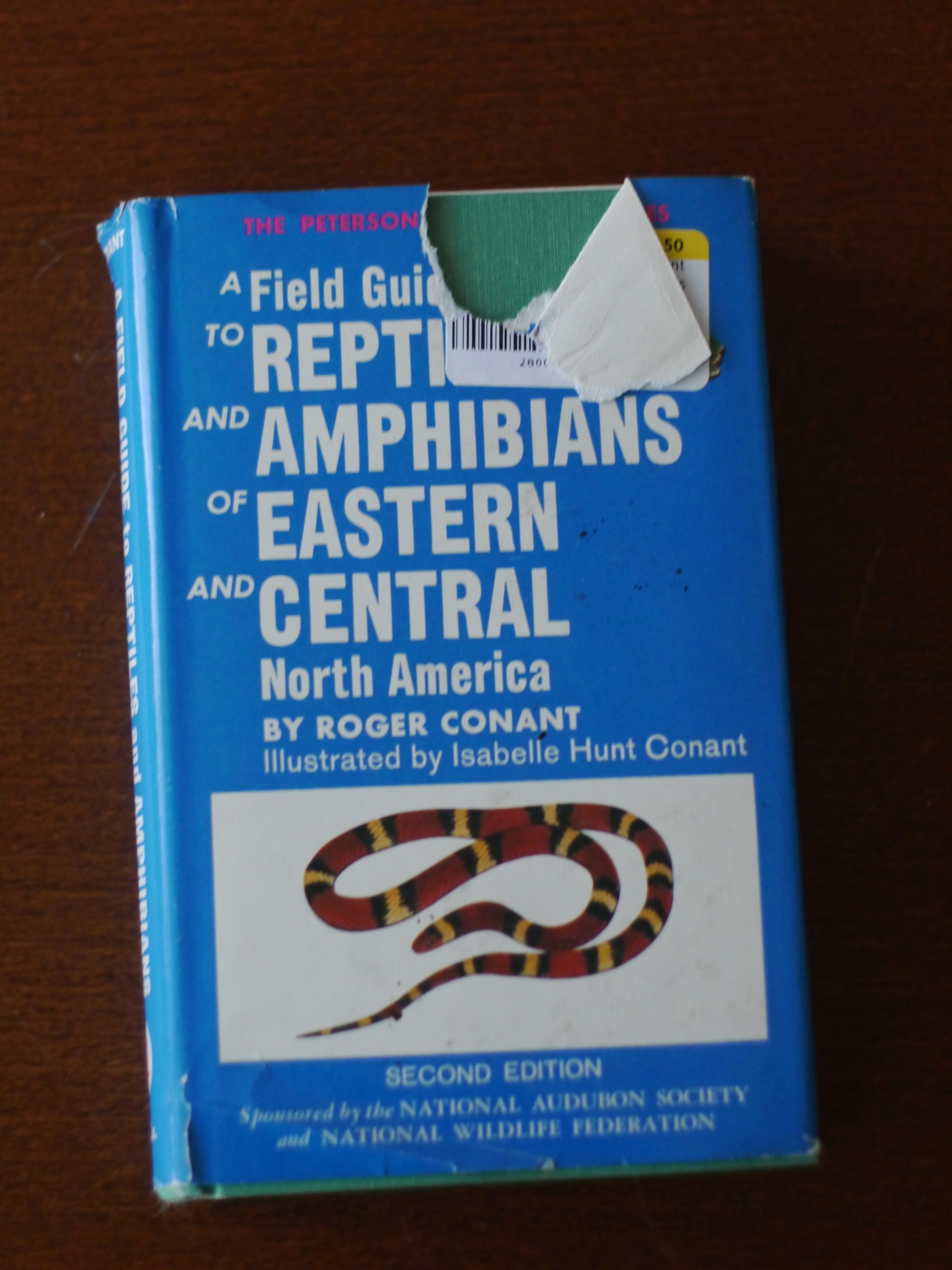
To start off, I’ve been collecting field guides of my own, and drawing up a reading list on the history of birding in America. Here’s some of the guides I’ve been accumulating:
And here’s what is going to be an invaluable help, Extinct Birds, by Errol Fuller, who has apparently written the definitive book on the subject, covering more than eighty species that have disappeared since 1600. He’s also written a book called Dodo, and one on the Great Auk. Apparently the Great Auk book is partly about the bird itself, and partly about all of the stuffed auks in collections around the world, all of the egg specimens, and the collectors who have collected these items. I’m super excited to get my hands on that one. I’m still not totally sure where I’m going with it at this point, but there will be birds, there will be some history of birding, and some discussion of the process of extinction. Good start, no? Aside from Errol Fuller, I’ve been reading up on John James Audubon. Here’s a great biography, if you’re interested.
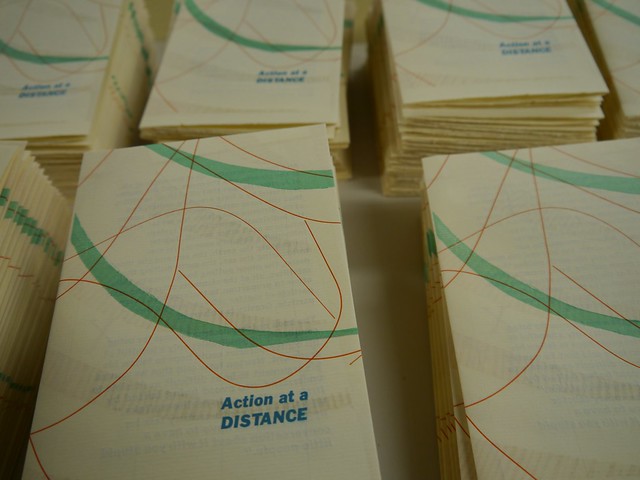
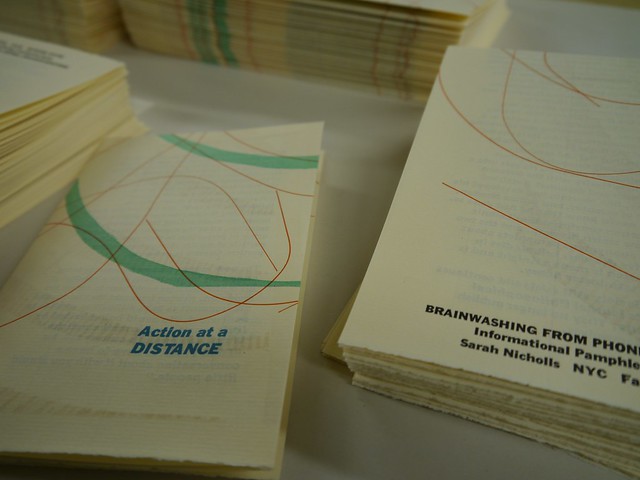
The first batch of new pamphlets are in the mail. Action at a Distance, the Fall 2012 Brain Washing from Phone Towers Informational Pamphlet, is an exploration of Isaac Newton, the Principia, and the beginnings of the Royal Society in London. Math! Plague! Mean Anonymous Pamphlets! Kids, the seventeenth century had it all.
I upped my edition size and increased the size of the recipient list this time around. So, if you’re new around here, welcome. Do you have some questions? I’ll try to answer them as follows:
What is this?
Clearly, it’s a free informational pamphlet. Like this one:
I got a new camera. I’m pretty excited about it.
Why did you send this to me?
Why not? I have a strictly whim-based distribution system.
Less evasively, I like to share the surprise. Printmakers like printmaking partly because it comes with a surprise inside; we spend lots of time making a plate, but we’re never quite sure how it’s going to look when we pull a print off of it, so when we do, bam, it’s a surprise. But people looking at the print later don’t get to have that experience, they just see a piece of paper. Anonymously mailing pamphlets to people is one way to spread the surprise around.
I have a list of people I send these things to, which changes for each pamphlet. Some people are always on the list, some people are sometimes on the list, some people just get one copy. It changes. Usually they are people that I’ve met or worked with over the last year or so, but sometimes they are strangers, or almost-strangers.
Why is it about Isaac Newton?
The real question is, why aren’t all of my pamphlets about Isaac Newton? He didn’t make friends until he was 45. He argued with almost everyone he met. He invented calculus and didn’t tell anyone. Cranky loners, that’s my favorite kind of people. Did I tell you about how, when he worked for the mint, he used to hunt down forgers and have them drawn and quartered?
Why does it look different from the rest of my mail?
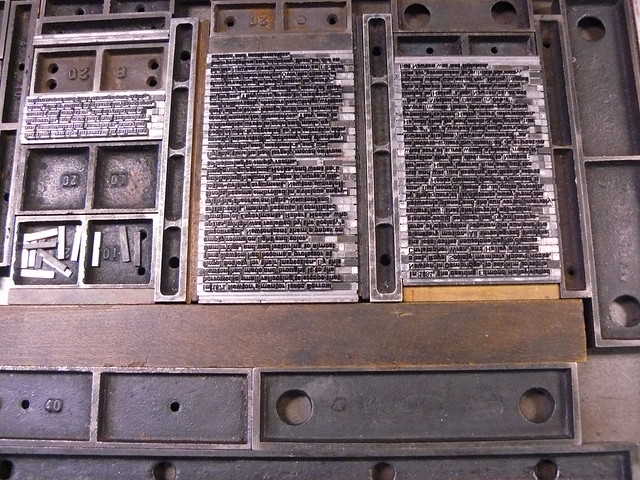
It’s printed letterpress, that’s why. From genuine metal type and woodblocks, just like the original edition of the Principia. Like this:
There’s more information here and here and here about how it was made.
Also, the rest of your mail is just bills and credit card offers. So it’s way better than that.
Why pamphlets?
I’ve posted this before, but I just love it:
“The pamphlet is a one-man show. One has complete freedom of expression, including, if one chooses, the freedom to be scurrilous, abusive, and seditious; or, on the other hand, to be more detailed, serious and ‘high-brow’ than is ever possible in a newspaper or in most kinds of periodicals. At the same time, since the pamphlet is always short and unbound, it can be produced much more quickly than a book, and in principle, at any rate, can reach a bigger public. Above all, the pamphlet does not have to follow any prescribed pattern. It can be in prose or in verse, it can consist largely of maps or statistics or quotations, it can take the form of a story, a fable, a letter, an essay, a dialogue, or a piece of ‘reportage.’ All that is required of it is that it shall be topical, polemical, and short.”
-George Orwell, in an introduction to the British Pamphleteer
Brainwashing from Phone Towers? What’s that all about?
Well, generally it has something to do with the distribution of information in a paranoid context. Less generally, but more tangentially, it has to do with this seminar I had to go to.
As a Professional Arts Administrator, I often get sent to Professional Development Workshops, because funders don’t just want to give us free money, they want us to do something called Capacity Building, which in my case usually means sitting through an hour long presentation about Why Your Organization Needs to Use Twitter. The last one I had to go to stuck out for me because the presenter was this guy with a headset on, like a drive-thru window headset, and he just kept walking back and forth and back and forth on the stage really really quickly, and shouting at the top of his lungs about his smart phone and about his twitter feed and his social media fan base and on and on and on and he just kept on yelling about how we all needed to be doing this because this is the most important thing that we all have to be doing, because this is all that matters, because this is the future.
And honestly, I have nothing against social media. I spend a lot of time with social media. Here I am, writing on the internet! But I have a lot against being bulliedinto using social media.
Also, you know all those studies on cell phones and brain cancer? The ones that say there’s not a link are all funded by the telecommunications industry. Just so you know.
Why don’t you just blog? Why bother printing something at all? Don’t you know it’s the future?
Because if I just blogged no one would read it. My mom’s the only person who reads this blog. And if you did accidentally stumble upon this blog for some reason, you’d get halfway through one post, then think to yourself, all of those words, all in a row, and then get distracted and go watch a cat video.
If you send someone something in the mail, hand addressed to them, printed letterpress so it’s all nice and special, people read that. That’s the truth. And most of the people I send these pamphlets to later reach out and say, hey, thank you for sending me that pamphlet. That was nice. And so for a brief moment in time I get to live in a civilized society. I enjoy that, I really do.
So in this week’s episode of ridiculously-time-consuming-acts-performed-in-my-limited-free-time, I give you pamphlet, side two:
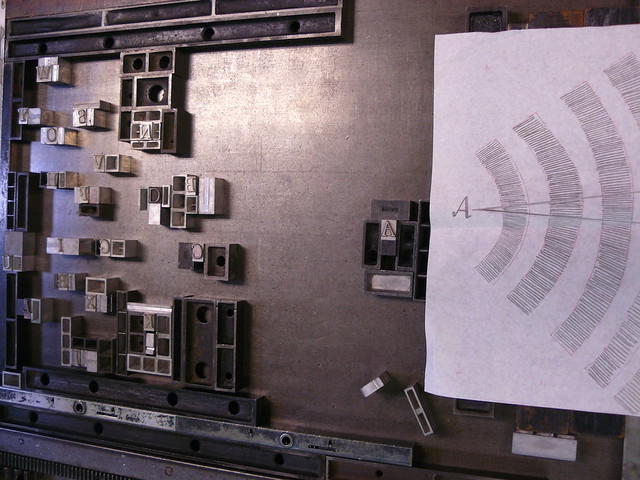
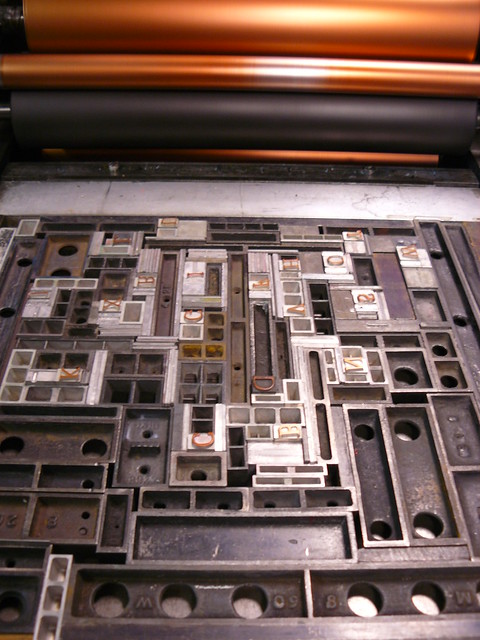
My favorite thing about letterpress is the fact that you have to build up something three-dimensional to print something two dimensional. So it’s sculptural and flat at the same time.
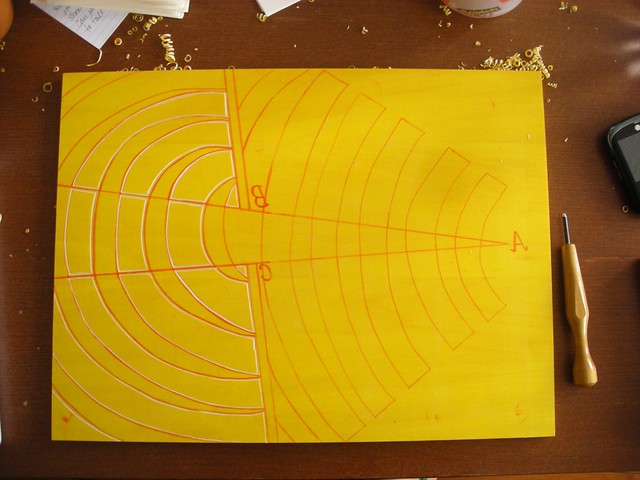
This can be something you carve:
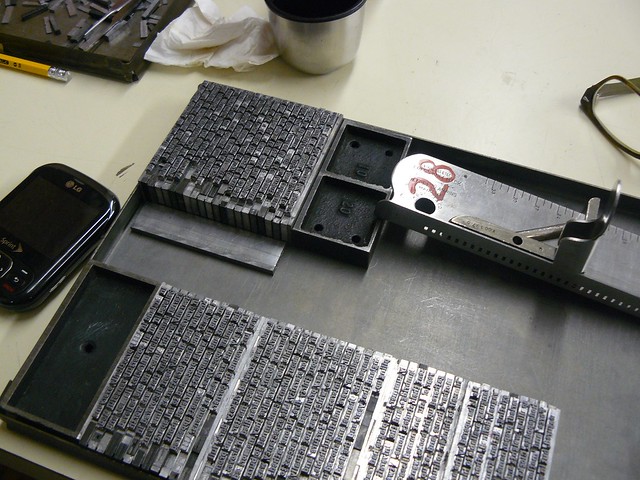
Or something you assemble out of thousands of tiny pieces of metal:
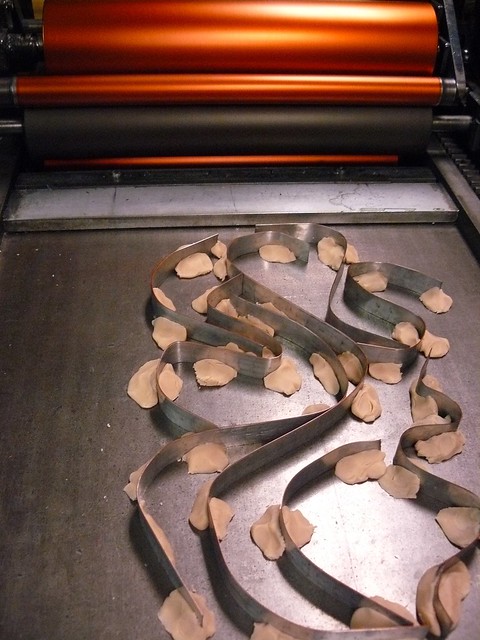
Or something you improvise:
But it has to hold still somehow. The image on the second side of the pamphlet is based on this one:
Which is a woodcut, and I had to decide when I carved my block if I wanted to bother carving the letters or if I wanted to use metal type for that part and print it separately. I went with the second option.
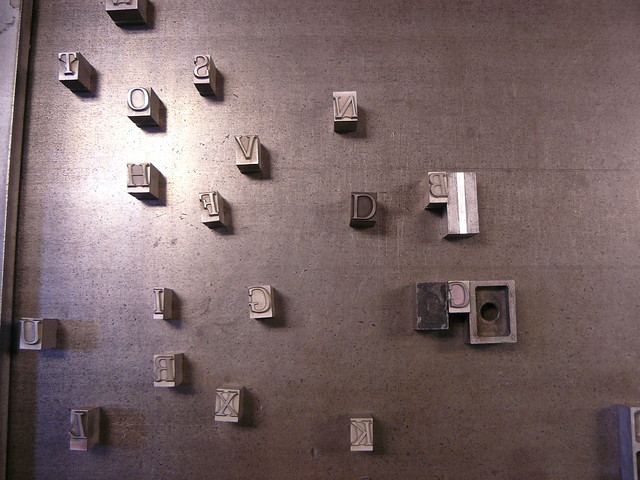
So far, so good. Except now I have to build a forme around it to hold all those letters in place.
Ok, that’s a start.
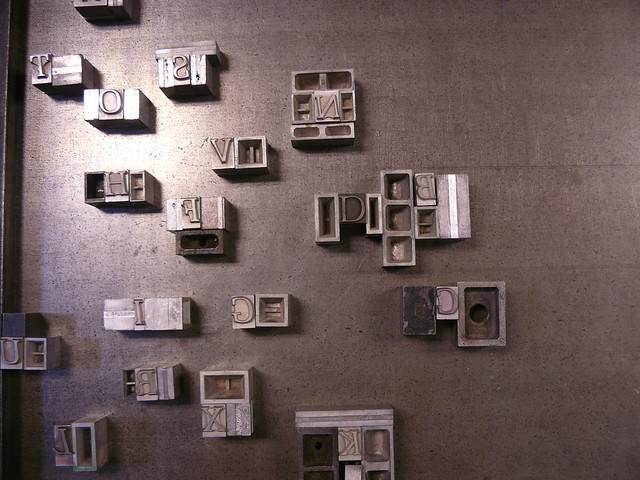
Better.
Best. See all that stuff around the letters? That’s empty space. One of my favorite things in the world is when two contradictory ideas are simultaneously true.
Though I’m clearly more comfortable in print. Talking in public! In Williamsburg this weekend! With the amazing Angie Waller!
Sarah Nicholls will be discussing her book Phosphorescent Face Highlighter that incorporates found text from sources such as Adolf Loos, The Landmark Forum, Weight Watchers, Le Corbusier, Alcoholics Anonymous, Oil of Olay and Dale Carnegie, among others. The pages are composed of linoleum cut illustrations, hand drawn and hand-set type.
Come out this Sunday and I will help you to lose weight, realize your potential, quit drinking, heal your relationships, design new contexts and paradigms, hide those tiny lines and wrinkles, build the city of the future, move beyond the tired aesthetics of the past, and much, much more.