
I ran 15 miles in an afternoon downpour today. Because I’ve got a lion heart that pumps lava through my veins. I love marathon training.

I ran 15 miles in an afternoon downpour today. Because I’ve got a lion heart that pumps lava through my veins. I love marathon training.

Anyone want to join me in Chicago the weekend of October 12-13? The list of speakers for the American Printing History Association National Conference is posted.


It’s mid-August, which means the end of summer is near, which means it’s time to say goodbye to my summer interns, who were amazing and learned a bunch and made me proud.

So I made them a pie. They printed a slew of great things, and installed some exhibitions, and were generally all you’d want an intern to be. Thanks for a great summer to Ian McCoy, Kate Trancynger, Samantha Palazzi, Shelley Picot, and Deborah Levinson.

The NY Times says so!


I’m working on a field guide. Field Guide to What? Still remains to be seen. So far I have a structure that I might like, and some images that I do like, but may not work, and some bits of text, and an idea of what to do with them. And I’m not sure how each of the parts relate to each other.
I also have the above flock of birds, they’re quite nice so far.

In between things at the moment. Half-working on some prints, half-working on a new book. Had an idea for a pamphlet in the shower this morning. August is slow.


Working on lettering for the catalog for our summer members exhibition. Go see it!
“The pamphlet is a one-man show. One has complete freedom of expression, including, if one chooses, the freedom to be scurrilous, abusive, and seditious; or, on the other hand, to be more detailed, serious and ‘high-brow’ than is ever possible in a newspaper or I most kinds of periodicals. At the same time, since the pamphlet is always short and unbound, it can be produced much more quickly than a book, and in principle, at any rate, can reach a bigger public. Above all, the pamphlet does not have to follow any prescribed pattern. It can be in prose or in verse, it can consist largely of maps or statistics or quotations, it can take the form of a story, a fable, a letter, an essay, a dialogue, or a piece of ‘reportage.’ All that is required of it is that it shall be topical, polemical, and short.”
-George Orwell, in an introduction to the British Pamphleteer
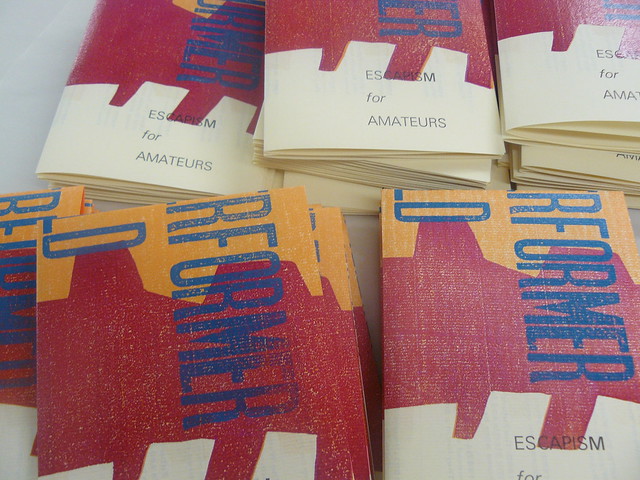
The fifth in a series of Free Informational Pamphlets is fresh off the press and about to go out into the world. Produced with the good graces of the Paper Fox Printmaking Workshop at Lawrence University, and the kind support of Benjamin D. Rinehart and his students, Escapism for Amateurs is an investigation of the life and times of Harry Houdini, favorite son of Appleton, Wisconsin and pioneer in the realm of escapologists, who built his career on demonstrating the ability to escape from a huge variety of restraints and difficult situations. Escapologists escape from handcuffs, straitjackets, cages, coffins, steel boxes, barrels, bags, burning buildings, fish tanks, and other perils, often in combination. The possibility of failure and death thrills their audiences.
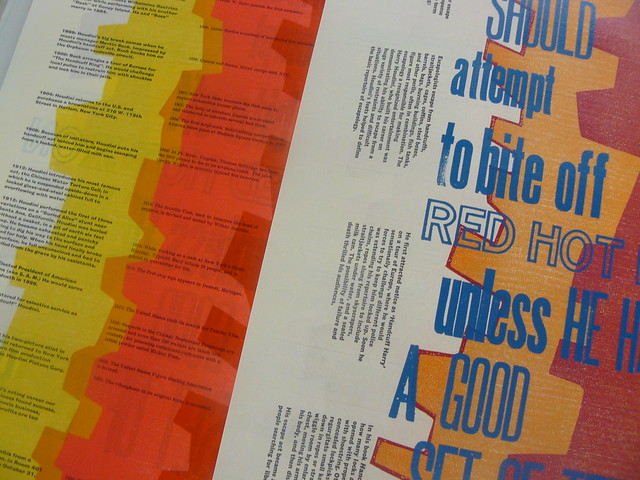
Escapism for Amateurs includes a graphic timeline detailing the life and times of Harry Houdini in an international context. Produced in an edition of 82, half the edition is going back to Appleton, Harry’s childhood home, to support the activities of Paper Fox, and the other half is going in the mail to lucky selected recipients. Huzzah!
“Our traditional printing business has fallen off,” VonColln said. “But compared to that, letterpress is growing. So the bright spot is letterpress.”


I started folding last night. Almost done!
