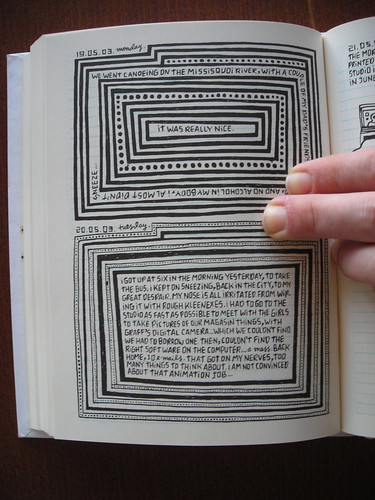
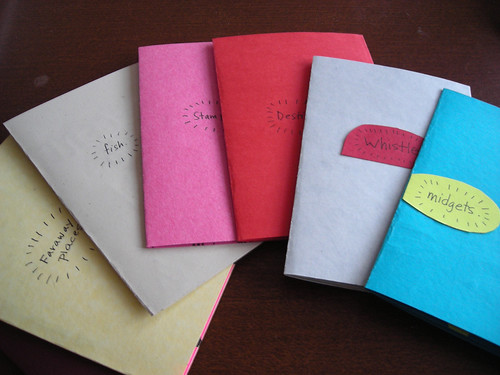
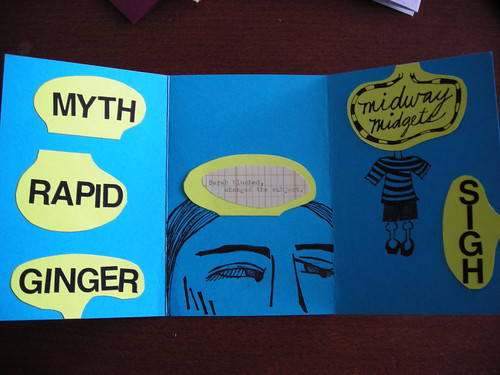
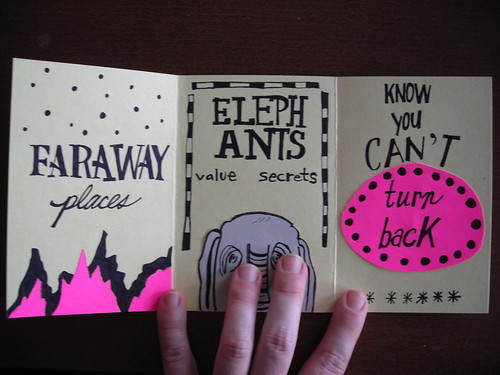
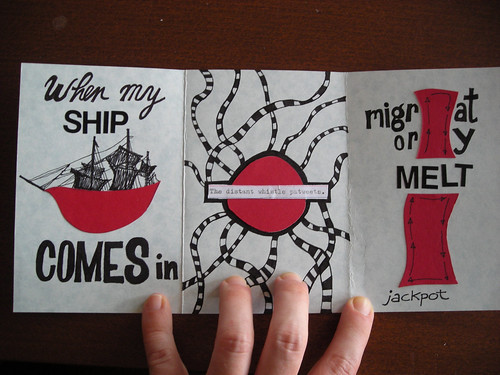
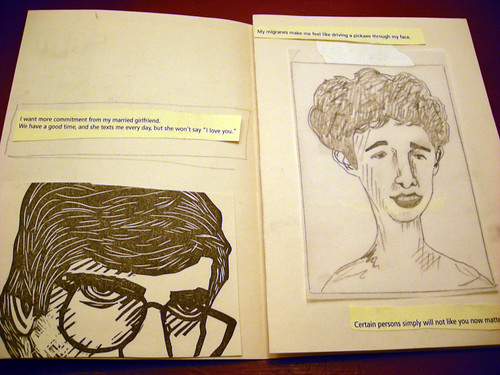
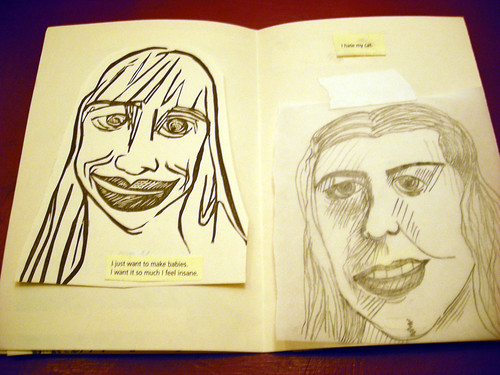
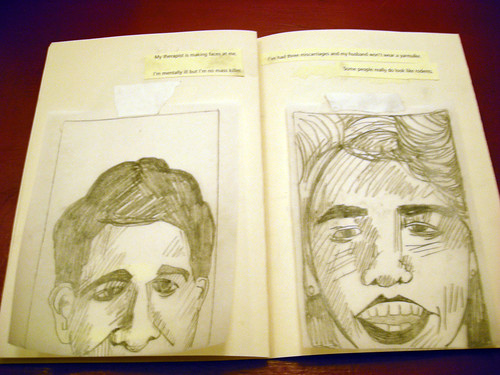
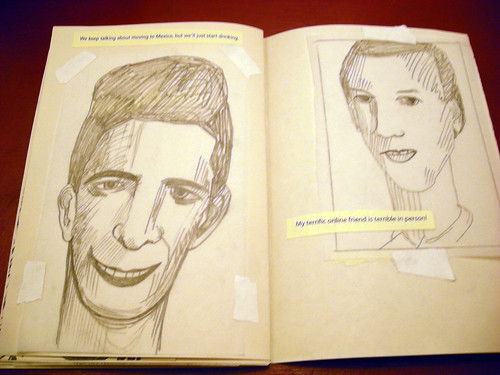
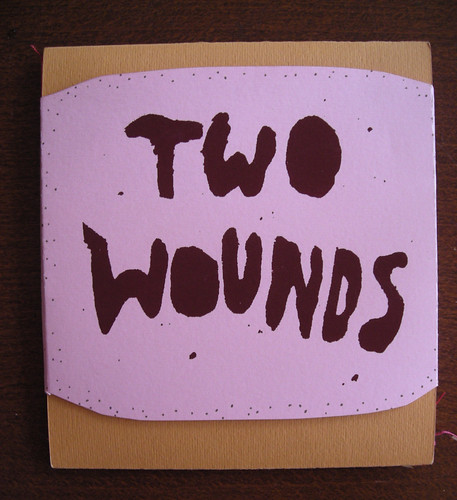
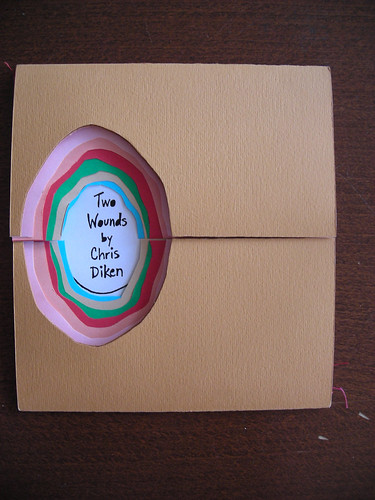
Two Wounds by Chris Diken, an awesome book.  Published by Uninhabitable Mansions, which seems to be a publishing collective? Perhaps? In any case, they have a sewing machine, and a good story, and a whole lot of hand cut pages.

And you can buy direct from the Uninhabitable Mansions website, as well as see lovely photos of other things they have made. You can also buy from Desert Island, the only place that can convince me to go to Williamsburg. 


I’m two-thirds of the way through this, which is unlike any other food writing I’ve read. MFK Fisher chronicles her gastronomical coming of age through a series of essays, about traveling with others and alone. She writes about food by talking around it, so that she forms a vivid and complete picture of where it sits within a whole life. It’s part cultural history, part natural history, part autobiography. And she has the most distinctive voice: 

 She was a stupid woman, and an aggravating one, and although I did not like her physically I grew to be deeply fond of her and even admiring of her. For years we wrote long and affectionate letters, and on the few times I returned to Dijon we fell into each other’s arms…and then within a few minutes I would be upset and secretly angry at her dullness, her insane pretenses, and all her courage and her loyal blind love would be forgotten until I was away from her again. 

She writes about people more than she writes about food, though the food is there, and it tells you about the people serving it or eating it with her, but there’s absolutely no sentiment in her descriptions of either. She talks about running away from too many fine gourmet dining experiences in Dijon, farming in Switzerland with her second husband and feeling enslaved by the land. She believes in the ideal of eating well, but knows that most people and lives and experiences fall far short. I love that push and pull, that dense sense of knowledge about pleasure. 

Next I plan to read How to Cook a Wolf, about cooking and eating well on a WWII rationing-era budget. I figure we could all learn something there.


I lost a week and a half of my life to a combination of pre-benefit invite madness and a nasty nasty cold.

I wish I felt clean. Mostly I feel like it’s going to be cold and wet forever, and I’m going to spend the rest of my life with massive amounts of snot clogging up my sinuses. I missed three different things because I thought they were going to happen, but really, they already did. 

Though I have gotten some work done.

And theoretically it will be spring soon. 

I finally finishes 365 Days by Julie Doucet, which has been hanging around the house since September. It was really nice. Like spending time with someone you really like. I read an interview with her where she says that she didn’t have any female friends when she just drew comics; now that she’s sworn off them she’s got a whole group of women friends. Though she’s still doing something comic-like, I think the difference is enough. Comics are like bluegrass, or fine press books, or tango, or anything else with a clearly defined structure and history. You can be a purist about it, and devote yourself to exploring that, but you can’t move it forward in the end. I also just read Seth’s Clyde Fans Book One which is so incredibly beautiful, but a great example of not moving forward. Not that I minded at all, forward isn’t the only way to go, not when it looks that good.

I’m going to content myself by moving around tiny bits of paper while I wait for my sinuses to drain and spring to spring.


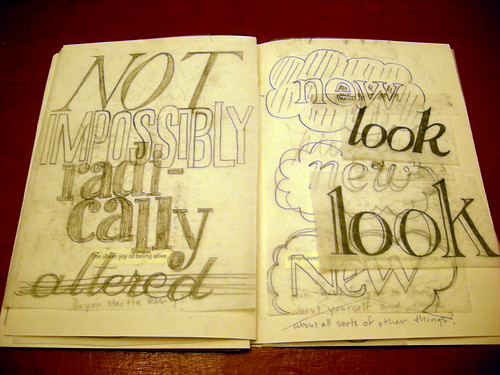
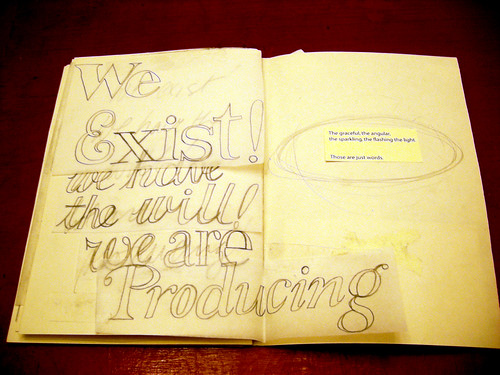
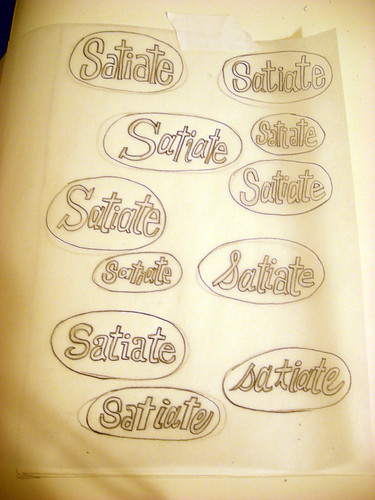
This is part of the next section of the book in progress. I’m still not sure about the rest of it; I may be fussing too much. 

I’ve tried to see a movie at film forum twice this month and failed both times. It should be easy, seeing a movie, no? 

It takes more than will, apparently.


There’s just too many things that I like about Dianna Frid’s work:

The materiality of it.

Dislocation of Snow, 2008.

The shifts of scale, large and small, books/ interior space and sculpture/ environments:

Greenhouse and Grove, 2006.

The link between pattern and texture and language.

Leak, Unique Book, 1999.

The ridiculous humor:

Floyd Collins, Cave Explorer, Unique book, 1998

From her website:

I make objects and images that span a wide range of scales and materials. My works take the intimate form of artist books, fiber works, and collages, or they function as sculptures, large drawings or as immersive environments.

One of the central themes of my recent work has been the relationship between diagrams, patterns and words and the things that these diagrams, patterns and words attempt to depict.

There’s so much great stuff on her website it was hard to choose just a few images. Click here to see more.


I’ve been making these for the CBA Lounge event this Friday – (details here). It’s the most fun I’ve had in a long time. Come by Friday night at 6pm and make some haiku comic books with us. Text, image, printing without a press with Corinna- and our dear friend Ana Cordeiro, brilliant bookbinder, will help us stitch together our creations.


I made the best pie in the world today. 

Pear Fig Pie with Hazelnut Crumb Crust. 

pie

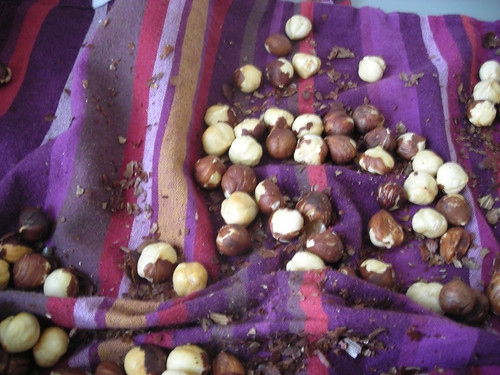
Whoo. I made it in bits, a crust one day, poaching figs another day. Toasting nuts in my spare time.

The leisurely approach to pie making. I’m keeping this one all to myself. So there. 

The month of January is about Finishing That Book, Dummy. Which means I have, count them, five more days, to be done with the dummy-making phase. No problem. 

It’s a faux self-help book, my book. 

I told someone this and they asked if it would help people. I said “no.”

They said that that was just like me. I thought that was mean. 

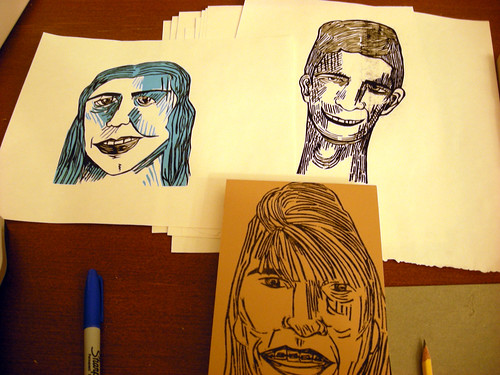
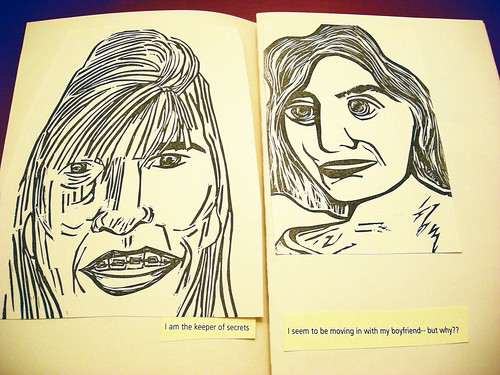
The first bit is case studies. These are the cases. 

The portraits are based on images from my high school yearbook.

Next up, the self-evaluation.


I really like organizations/people/books/work/ activity that are many things at once. That’s why I like artists books, that they simultaneously touch on visual art/writing/language/performance/sculpture/illustration/sound/time/etc…. Being able to enjoy something in different ways depending on your interest, appealing to different kinds of audiences at once-I like the tendency (or at least the desire) to bring different kinds of groups of people together in that way. (The study of artists books, well, that’s something else entirely, which seems to have a talent for breaking things into tidy groups and cliques and well-defined activities. But that’s besides the point.) 

There’s a show on where I work right now about historical and contemporary artist collectives who publish books, in various ways and in various places, and I’ve been thinking a lot about how these organizations have made a way in the world. These groups publish as part of so many different activities (educational, activist, literary), some of them as part of artist co-op workshops, some not, that it makes you focus of the book as a set of possibilities, as a starting point to work out from. I’m really interested in the ways these organizations have found so many different ways to provide a real support structure for artists, that intersects with real-world economics of, how do operate a business and produce work that you’re proud of? 

Which brings me to the Regional Assembly of Text, which is a small business, and a store, and a publishing concern, and an art project all rolled into one. On their site they define themselves as a little stationary and gift store, which seems a little on the modest side to me. 

I like the populist approach to the artist book, that it’s about things that people like to read. I like the well-designed storefront and retro office supply aesthetic. I like they have a storefront and a gallery, because in the end both are storefronts anyway. Most of all I like that it’s an activity first and foremost, which manifests itself in a variety of ways, in an accessible form of language.  

I love this, which you can purchase here for a mere $6. I’m always looking for ways to increase my level of accomplishment. It’s the overachiever in me.

The exhibition Artist’s Books as (Sub)Culture is up until March 28th in New York, you can see some photos from the show here.

I’m within twenty pages of finishing Infinite Jest, and I’m dragging it out as long as possible. It’s like trying to avoid being dumped. I’ve spent months with this book, I’m invested. It doesn’t help that he’s saved the really sad, gross addiction stories for last. I’m sort of at a loss as far as what to do next.

It’s the kind of book smarty-pants like for its creation of new forms of reading; and it does that, it’s true. I like the footnotes, I like the back and forth, the fact that you need two bookmarks, the pyrotechnics involved in writing a thousand plus page novel with no ending and hundreds of digressions. But that isn’t why people like it, or why they bother with it, it’s because it’s an enormously compassionate, funny, enjoyable book, with characters that feel like family. And the pyrotechnics make sense if you think that only an addictive, obsessive personality would write a thousand page novel about addictions and obsessions with hundreds of footnotes. It’s not driven by theory, it embodies them in the midst of telling a story. Which I like.


@