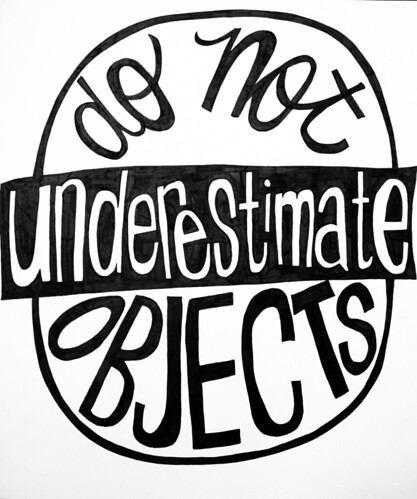
Some people don’t like to let go. Some people have to hold onto their pain to make sure that it means something. Objects are solid, are reliable, are specific. You can leave an object in a place and it will tend to stay there. Objects are grounded in time, they record time. They are tactile, collectible evidence of thought and activity. Do not underestimate objects.
1. This is some beautiful type.
2. I spent Thursday night at the NY Art Book Fair, Printed Matter’s yearly artist book fest. Why is it always hot no matter where they hold it or when it is? I drank some disappointing cocktails and looked at a lot of books. Drawn and Quarterly were there, happily with this lovely book by Julie Doucet.
She’s my fantasy guest artist I’d like to bring to my unnamed place of employment. Did you know this was a translation?
That means she drew the entire book in french, then re-lettered the entire damn thing in English. Does that amaze you as much as it amazes me?
3. Today, I made parsnip-carrot-sweet potato pancakes, apple-blueberry crumble pie, and roasted some squash. I have now used up the last of my CSA fall vegetable crop. I have blueberry juice all over the bottom of the oven.
4. This place cannot be.
5. The wall is coming along nicely, thank you.
I’m not sure about the pink.
I got an email tonight requesting that no one in my CSA tap on the glass tank where the local elementary school’s brand new pet snake is going to live. Was someone very worried about this?
I have about five million more work-related events to go to this week than I would like to. I find the thought of it exhausting. What I would like to do, which I will most likely not have much time to do, is spend more time reading this.
I started reading it recently, after poor David Foster died and I suffered some guilt pangs over not making an effort to read his big novel before this, and am making slow, slow progress. Schlepping it around is giving me a stiff neck, and holding it up on the subway in the morning often makes my arm sore. But it’s just so, so good. I want it to go on forever, which it very well might.
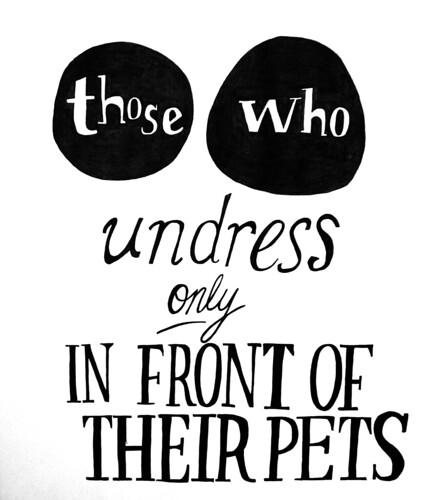
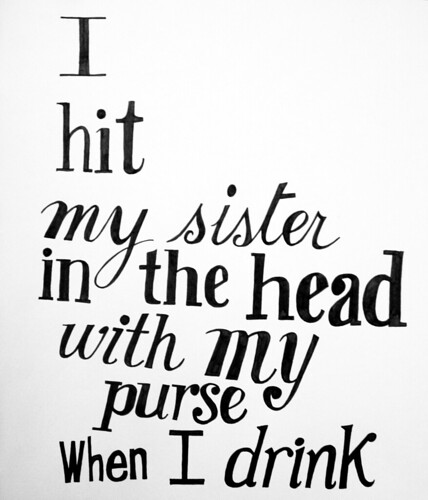
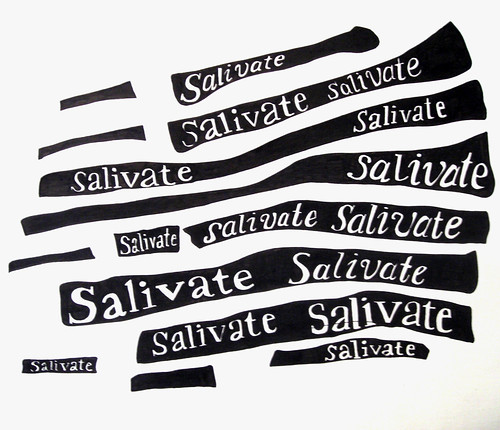
I’ve been working on these drawings for over a year now; there’s something so comforting about working on them. One phrase or two; maybe just a word. Black ink on white paper. It’s just so simple. I’ve been thinking about making both a book and an animation out of them, but it’s the stringing together into something coherent that begins to trip me up. I like that they’re like the voice in your head. That same quality is what makes it hard to string them together into something else. That voice in my head tends to go in circles, not into anything sensical. That’s why when people ask me what I’m working on, I’m likely to just say ‘nonsense’.
This may be of interest for some:
The Hot Iron Press visiting artist program grants artists the opportunity to introduce printmaking processes into their body of work while interacting with the culture, setting, and art community of New Orleans. We are currently seeking artists working in any media who desire a chance to create an edition of works using screen-printing, relief, and/or letterpress printing.
There’s no deadline; you can find more information here: http://www.hotironpress.com/visitingartists.htm
So here’s the thing about bacteria.
They’re everywhere. Huge colonies in your gut, in your mouth, on your skin, in your ear, in the sink, on the floor. Everywhere. When you use an antibacterial soap, or wipe, or that weird antibacterial hand gel that dries your skin up, it skins a small proportion of the bacteria off of the surface, mostly the kinds that are supposed to be there. Bacteria stops tooth decay. Lowers the incidence of depression. Prevents you from developing allergies, makes it less likely you’ll develop asthma, may prevent cancer. There’s as many beneficial forms of microbes, if not more, than there are ones that cause disease in humans. Antibacterial wipes often just make room for bacteria that means you harm. Which can freely multiply now that they have no competition. This is what people are talking about when they talk about drug-resistant staph infections; that nasty looking thing on the person’s face on the news was caused by too many antibacterial hand creams. If you sterilized your intestine, you would not be able to digest food.
You walk around thinking there’s a clear line between alive and not alive. You think of that scene on Sesame Street, with Grover pointing to a rock and saying Not Alive, then pointing to himself and saying, Alive. But on that rock are millions upon millions of bacteria, going about their day, playing a role in an entirely different universe going on right in front of him. The world is seamlessly and continuous living, if you take everything in it into account.
You can map your world in many ways; the streets in your neighborhood, the people and relationships that tie you to others, health statistics for people in your demographic, population density versus mortality rates, consumption patterns, infection rates. There’s a famous map of a cholera outbreak in London in the nineteenth century; it’s the classic example of the art of epidemic mapping. The man who drew it, John Snow, was a self-taught scientist (does such a thing exist anymore?) who lived in the neighborhood where the outbreak took place, and who worked with a local priest to gather enough information to track the source of the outbreak. It’s more a product of intimate local knowledge of a community than of scientific knowledge; bacteria hadn’t been discovered yet, they didn’t know what they were really looking for. They just knew when they drew out who lived where, what their habits were, what they did and did not have in common, and who died where, that a public water fountain looked to be the culprit.
You can draw a map of the world that is apparent to the naked eye, and you can also draw a map of the world you can’t see. You could maybe also draw a map of them both, how they interact. You can trace how the macro and the micro relate.
I think that I turned some kind of corner when I realized that no single moment in time was unendurable in and of itself. I think right after that point was the point where I realized that if you focus of your attention towards something boring and monotonous, it stops being boring and monotonous.
I came across this today:
Daily life has become a cacophony of experiences that disable our senses, disconnect us from one another and damage the environment.
But deep experience of the world– meaningful and revealing relationships with the people, places and things we interact with– requires many speeds of engagement, and especially the slower ones.
‘Slowness’ is a holistic approach to creative thinking, process and outcomes. It envisions positive human and environmental impacts of designed products, environments and systems, while constructively critiquing the processes and technologies of which they are born. It celebrates local, close-mesh networks of people and industry, it preserves and draws upon our cultural diversity, and it relies on the open sharing of ideas and information to arrive at innovative solutions to contemporary challenges.
I get nervous whenever someone starts talking about deep experience of the world. I should probably get over that. The above is from slowlab, a nyc organization that promotes ‘slow design’, by fostering exhibitions, events and other projects. They have involved a really broad range of individuals, urban planners, designers, makers and academics from a variety of disciplines, which is exciting to see. You can read more here: http://www.slowlab.com/
The photos are from my met trip yesterday. Arms and armor really are everyone’s favorite. I always wish the lighting was better in the period rooms, I’d like more photos of those. Then I went to the park, which was more crowded than I would have liked. Then I went home and made this:
And this:
Which is coming along nicely. And so I had a perfect Sunday.

I started running consistently about a year ago, as an attempt to spend more time doing things I claimed to like. It’s probably the best part of my day. I’m a slow runner, and part of why I like it is it’s about slow changes over time. I can run only two more miles now than I could at the beginning, and can run them faster, but the difference is slight, really considering how much time I spend at it. I like that its something you practice and cobble together over time.
It helps that I’m running in one of the best parks I know. It’s a lovely way to begin a day.
I’ve been working on things like this for awhile:
which will eventually be a book, and which will also, hopefully, be a video, which will also, hopefully, be cobbled together over time. And show time, and show language over time. The language itself being about the rhetoric and mechanics of transformation, which usually takes place over time, though people object to that quality and would like to speed up the length of time it takes to transform, time being precious and all, and language being easy to manipulate. It’s easier to tell a story about transformation than it is to transform, or at least it takes less time. Time being the thread that’s connecting this to running, and to my job, which is both short of time, and long-lasting, and to this:
which will hopefully grow over time. There’s something perverse about setting lead type by hand, printing it, then cutting it back into little pieces that I enjoy. A perverse use of time, which is perhaps also how I feel about blogging about slowing down time. Blogs also, of course, being something that is generally cobbled together over time, which might mean I will like it and continue doing it, or perhaps not.